 11
Upgrade incentives on travel credit cards are commonplace in the industry. Issuers like Delta Air Lines and American Express frequently prompt cardholders to transition from popular entry-level options like the Delta SkyMiles Gold American Express Card to mid-tier products such as the Delta SkyMiles Platinum American Express Card, promising increased travel perks in exchange for a significantly higher annual fee. But beneath the allure of elevated benefits, travelers are left to wonder whether taking the bait on an upgrade offer actually makes financial sense.
In the vast majority of circumstances, the answer is a straightforward and resounding no. Upgrading rarely makes sense for travelers who want to maximize their point-earning potential. However, making the right financial decision requires a thorough understanding of the complex rules, restrictions, and eligibility guidelines that govern both product upgrades and new credit card applications within the current rewards ecosystem.
Understanding the underlying framework is essential before deciding whether to pull the trigger on a Delta card upgrade or pursue an alternative strategy.
Evaluating credit card strategies requires looking closely at how major financial institutions police their application pipelines. Every bank enforces its own unique set of rules and restrictions around credit card approvals. For instance, Chase is widely known for its strict 5/24 rule, which automatically denies applicants if they have opened five or more personal credit cards across any bank within a rolling 24-month period.
American Express operates under a fundamentally different philosophy. Amex historically enforces a once-per-lifetime rule on welcome bonuses for each of its individual credit cards. Under this guideline, if an individual has held a specific Amex card in the past, they are generally ineligible to earn a welcome bonus on that exact same card again. In practice, however, this lifetime restriction is not permanent. Industry data indicates that Amex typically resets eligibility roughly seven years after a specific card account has been closed, and occasionally even sooner under certain promotional conditions.
Therefore, while American Express may not scrutinize an applicant’s broader credit card portfolio across other competing banks with the same intensity as Chase, they closely evaluate past relationships with specific Amex products—regardless of whether a welcome bonus was actually earned during that previous tenure.
This landscape shifted notably when American Express introduced stricter policy guardrails across its co-branded Delta SkyMiles card portfolio. These regulatory updates made it substantially more difficult to qualify for welcome bonuses based on a consumer’s historical ownership of other cards within the same airline family.
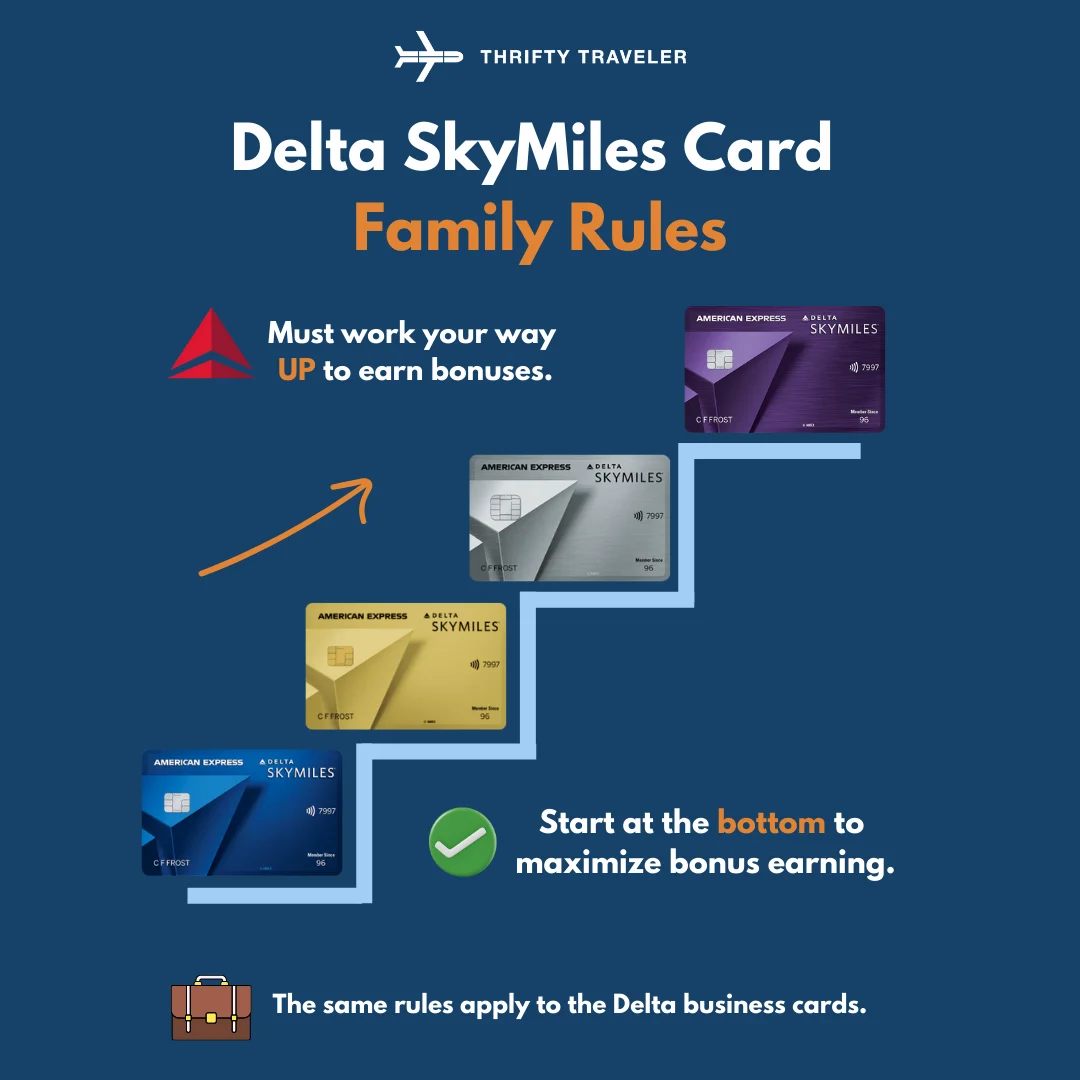
The current system allows cardholders to theoretically work their way up the hierarchy of Delta cards, earning a welcome bonus on each progressively higher tier, but prohibits moving backward. For example, a consumer who has previously held the Delta SkyMiles Platinum Card is barred from earning a bonus on the lower-tier Delta Gold Card. However, that same individual remains fully eligible to pursue a welcome bonus on the top-tier Delta Reserve Card.

The crucial takeaway is that the Delta Gold, Delta Platinum, and Delta Reserve products are treated as entirely distinct credit card accounts. This distinction means consumers are legally and structurally permitted to open each card individually and collect a welcome bonus on every single one, provided they apply in the correct strategic sequence.
When Delta and American Express launch aggressive promotional campaigns featuring elevated welcome bonuses on SkyMiles cards, their primary objective is acquiring new cardholders. Simultaneously, however, issuers target existing customers with personalized upgrade incentives designed to nudge them into higher-tier products without triggering a brand-new account opening.
Accepting these upgrade offers often carries a hidden cost. Taking a direct product upgrade from a lower card to a superior card typically disqualifies the cardholder from ever earning the much larger, highly lucrative welcome bonus associated with applying for that higher-tier card outright.
Consider a recent targeted upgrade offer sent to existing cardholders, proposing a transition from the Delta SkyMiles Gold Card to the Delta SkyMiles Platinum Card in exchange for 30,000 bonus miles and a $250 statement credit after meeting a $3,000 spending requirement within the first six months. While earning extra miles and cash back sounds appealing on the surface, that promotion pales in comparison to the standard public welcome offers available to brand-new applicants, which frequently reach as high as 90,000 SkyMiles and a $300 statement credit after fulfilling a higher minimum spend.
While the exact welcome bonus for a new application is no longer a static figure due to American Express’s shifting "as high as" offer format across the SkyMiles portfolio, applicants can safely check their precise eligibility before a hard credit pull occurs. Through Amex’s digital "Apply With Confidence" feature, prospective cardholders submit an initial application and discover their exact approved welcome bonus offer before officially accepting the card and committing to the inquiry.
Because of how Amex structures its application rules, holding a Delta Gold Card does not prevent a consumer from applying for a Delta Platinum Card separately. Meeting the minimum spending requirement on a newly approved card unlocks the full, maximum welcome bonus—provided the applicant has not previously earned a bonus on that specific card or the Reserve variant. Upgrading instead sacrifices that future earning potential entirely.
Similar calculations apply to the ultra-premium Delta Reserve Card, which is heavily marketed for its access to Delta Sky Clubs and accelerated paths toward Medallion elite status. Upgrading an existing Gold card directly to a Reserve instantly eliminates eligibility for both the Reserve and Platinum welcome bonuses. Skipping the upgrade and applying for the Reserve outright preserves at least one major welcome bonus opportunity. Ultimately, analytical travelers find that Amex’s targeted upgrade offers almost never rival the financial return of opening a brand-new line of credit.
While the path upward is fraught with bonus restrictions, moving in the opposite direction has become a much safer financial maneuver. Thanks to updated welcome-offer eligibility restrictions implemented by American Express, downgrading an existing travel credit card is now a viable strategy for cost-conscious consumers.
Cardholders who currently maintain a SkyMiles Reserve Card but find themselves dissatisfied with recent restrictions and visit caps on Delta Sky Club lounge access now have a practical escape hatch. By proactively downgrading the account to the Platinum or Gold card tier, travelers can substantially reduce their annual fee overhead without permanently damaging their future bonus eligibility.

If spending habits or airline loyalty shifts down the road, American Express may even extend a future upgrade offer to entice the consumer back into a higher tier. Because modern rules focus heavily on preventing bonus double-dipping from upgrades rather than penalizing strategic downgrades, reducing a card’s tier carries far fewer risks than it did in the past.
Navigating card upgrades versus new applications also requires examining the mechanics of credit scoring. Applying for a brand-new credit card inevitably triggers a hard credit inquiry on the applicant’s credit report. While a hard inquiry typically results in a temporary, minor dip of five to ten points in a credit score, that impact is short-lived. Responsible use of a new credit line ultimately increases overall available credit, lowers credit utilization ratios, and strengthens long-term financial health.
Product changes, such as upgrading or downgrading an existing account, function differently. Banks treat these transactions as internal product conversions rather than new applications. The cardholder retains their existing account history and, in many cases, even keeps the same physical card number. Because no new credit line is formally established, the issuer does not need to perform a hard credit pull.
The undeniable trade-off for avoiding a hard inquiry, however, is the complete forfeiture of the lucrative points and miles bonuses that come with opening a brand-new account.
American Express currently maintains a portfolio of four distinct personal co-branded credit cards with Delta Air Lines, each tailored to different travel frequencies and spending habits. The entry-level Delta Blue card serves as a functional parking spot for consumers looking to eliminate annual fees entirely during a downgrade, though its minimal rewards make it largely unappealing for active travelers.
For most casual flyers looking to enhance their airport experience with checked bag waivers and priority boarding, starting with the SkyMiles Gold card remains a sensible baseline. However, periodically elevated, limited-time welcome offers on the ultra-premium Delta Reserve card can completely alter the calculus, making it mathematically advantageous to bypass lower-tier bonuses entirely and secure the top-tier card straight away.
The Delta Reserve card anchors the upper echelon of the portfolio with premier lounge access and elite status-boosting mechanics, while the Platinum card bridges the gap with companion certificate benefits and accelerated status progression. The Gold card rounds out the mid-tier options as a reliable workhorse for everyday airline spending without an excessive annual commitment.
Deciding whether to upgrade a SkyMiles credit card or apply for a brand-new account rarely requires a complex calculation. For the vast majority of consumers navigating the travel rewards space, applying for a new card outright yields far greater long-term value than accepting a quick, low-yield upgrade offer, ensuring eligibility for maximum welcome bonuses along the way.