 11

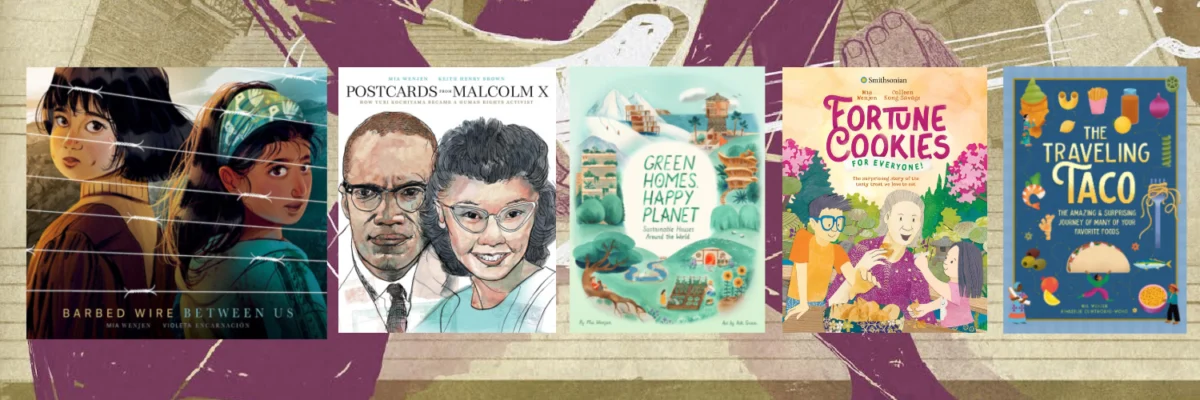
The picture book offers a moving and accessible portrait of Yuri Kochiyama, tracing her evolution from an ordinary individual into an extraordinary champion for human rights. The narrative centers on a pivotal moment in 1963 when Kochiyama, a Japanese American activist, shook Malcolm X’s hand at a New York courthouse. That simple yet monumental gesture sparked a profound and lasting friendship built on a shared foundation of justice, solidarity, and hope. Through narrative storytelling and evocative artwork by Keith Henry Brown, the book introduces young readers to an unsung hero of the civil rights movement, illustrating how two leaders from entirely different communities became bound by a common vision of equality.

To provide readers with a comprehensive historical context, Postcards from Malcolm X features original postcards sent by Malcolm X himself, extensive back matter, and a detailed timeline. This careful curation transforms the biography into both a powerful history lesson and an inspiring call to action for the next generation. Wenjen notes that her primary intention behind writing the book was to highlight intersectional, cross-racial solidarity as a historical example that can inspire similar collaboration in contemporary society and in the future.

Reflecting on Kochiyama’s life, Wenjen emphasizes the importance of portraying the activist’s developmental journey rather than presenting her as a finished product from the start. Kochiyama began her life as a self-described naive "All-American" who grew up believing that racism did not exist, as it had never directly affected her throughout her childhood and high school years. That protective bubble burst dramatically with the outbreak of World War II and the subsequent forced internment of Japanese Americans by the United States government. Her family’s harrowing experiences during the war, combined with her father’s tragic death at the hands of the FBI and her early volunteer work supporting Japanese American soldiers, catalyzed her awakening as an activist.

During her formative years, Kochiyama honed a specific set of skills that would later define her leadership style. As a high school journalist, she developed exceptional writing abilities. Furthermore, she was naturally gifted as a people person, possessing strong social-emotional intelligence and a collaborative leadership approach that naturally drew others into her causes.

Once her activist journey brought her to the Harlem community in New York City, her path crossed with Malcolm X. Kochiyama would later write in her autobiography that Malcolm X was the individual who taught her the most about the mechanics of activism. While she was already deeply engaged in grassroots community work in Harlem, she initially lacked a clear understanding of the systemic and structural levers that fueled the racism she and her neighbors faced. Malcolm X, recognized as a naturally gifted educator capable of breaking down complex sociological and political concepts into understandable terms, stepped into the role of both mentor and friend. That mentorship eventually led to his promise to write to Kochiyama during his upcoming international travels, resulting in the series of historic postcards that anchor the book’s narrative.

Following Malcolm X’s tragic assassination, Kochiyama dedicated herself to preserving and sharing his legacy. She created an educational curriculum centered around his teachings and political philosophy, which she frequently presented in schools and community centers. In many ways, Kochiyama’s lifelong evolution into a steadfast human rights activist served as a continuous tribute to the vital work pioneered by Malcolm X.

Wenjen points out that the deep friendship between Kochiyama and Malcolm X provides a realistic and honest blueprint for what it truly takes to bridge racial divides, even among minority groups that are ostensibly fighting the same overarching struggle. Building that bridge was not instantaneous or effortless. Kochiyama was required to prove her dedication to the Black Civil Rights movement by showing up consistently, doing the labor behind the scenes, and working tirelessly without seeking personal credit or recognition. When she first approached Malcolm X, he was understandably skeptical and questioned her underlying motivations, particularly given his status as a prominent public figure and civil rights celebrity.

This foundational hesitation, suspicion, and initial hostility may help explain why meaningful cross-racial solidarity remains difficult to achieve in modern society. However, Kochiyama’s unwavering commitment stands as an enduring role model, demonstrating the persistence required to authentically support diverse causes across different ethnic communities. Through this biography, Wenjen hopes to show children not only the immense power that comes from uniting across differences, but also the genuine dedication and emotional labor required to forge those vital connections.
In celebration of the book’s release day, Wenjen has announced a promotional giveaway offering five free copies of Postcards from Malcolm X. Readers and educators interested in participating are invited to leave a comment detailing how they plan to utilize the book in their homes, classrooms, or community programs. The release is further supported by a rich collection of related resources, interviews, unboxing videos, and previous works by Wenjen, continuing her extensive literary contributions to multicultural history, social justice, and youth activism.