 11
For Ronald van der Hilst—the acclaimed Dutch landscape architect and designer based in Antwerp—one horticultural creation celebrates his lifelong calling above all others. Ironically, it happens to sit just across the street from where he lives in a meticulously renovated 19th-century former coachman’s house.
The site is an ethereal, hidden space known as the Hortus Conclusus, derived from the Latin phrase for an enclosed garden. Historically, these sequestered sanctuaries were vital components of religious architecture around the world, most notably associated with monasteries and convents. Designed with defensive and practical utility in mind, their high walls kept wandering animals out while safely nurturing fresh water sources, medicinal herbs, vital vegetables, and symbolic flowers within.

Today, this particular iteration belongs to St. George’s Church (Sint-Joriskerk), situated on Mechelseplein, a quiet, leafy street tucked just around the corner from a vibrant, bustling square in the historic heart of Antwerp.
Van der Hilst’s deep involvement with the sanctuary was planted back in 2018. As a local resident, he had long admired the parcel of land. That year, the clergy approached him with what he describes without hesitation as a "godsend of an opportunity." The church community no longer used the walled space, and over time, the upkeep had transformed the once-sacred plot from a blessing into an administrative and physical burden.
Recognizing both the challenge and the profound potential, van der Hilst agreed to step in on one strict condition: he needed a significant degree of creative freedom to truly make the space his own. Given carte blanche by the church leadership, he eagerly began writing a horticultural story that would bloom continuously through all four seasons.

"This garden means the world to me: It grounds me to this specific place, making me feel as though I have finally achieved a sense of completeness," van der Hilst reflects, looking out over the verdant pathways. "It gives me immense satisfaction to see how I have managed to bring a place in the city back to life, turning it into a true oasis within the desert of the urban context."
Van der Hilst’s passion for horticulture is not a recent hobby; it is a lifelong vocation rooted deeply in his childhood. Growing up in Bennekom, in the Netherlands, he spent his formative years surrounded by nature. Near his childhood home, he recalls a particular spot in the nearby woods that left an enduring, magical impression on his young imagination: a hidden forest clearing where an anonymous local maintained a vegetable patch.
"I never saw the person, but it had something surreal about it," van der Hilst recalls of that formative memory. "A garden right in the middle of nature, a world unto itself." That early fascination with secluded, self-contained edible and floral sanctuaries bears a striking resemblance to the secret urban haven he now cultivates in the heart of Belgium. Before taking on the Hortus Conclusus, he maintained a private personal garden outside of Antwerp for several years, further refining his hands-on philosophy of landscape design.

"I simply need hands-on contact with plants and the soil—to witness what the seasons bring and be connected to what lives and decays," he explains.
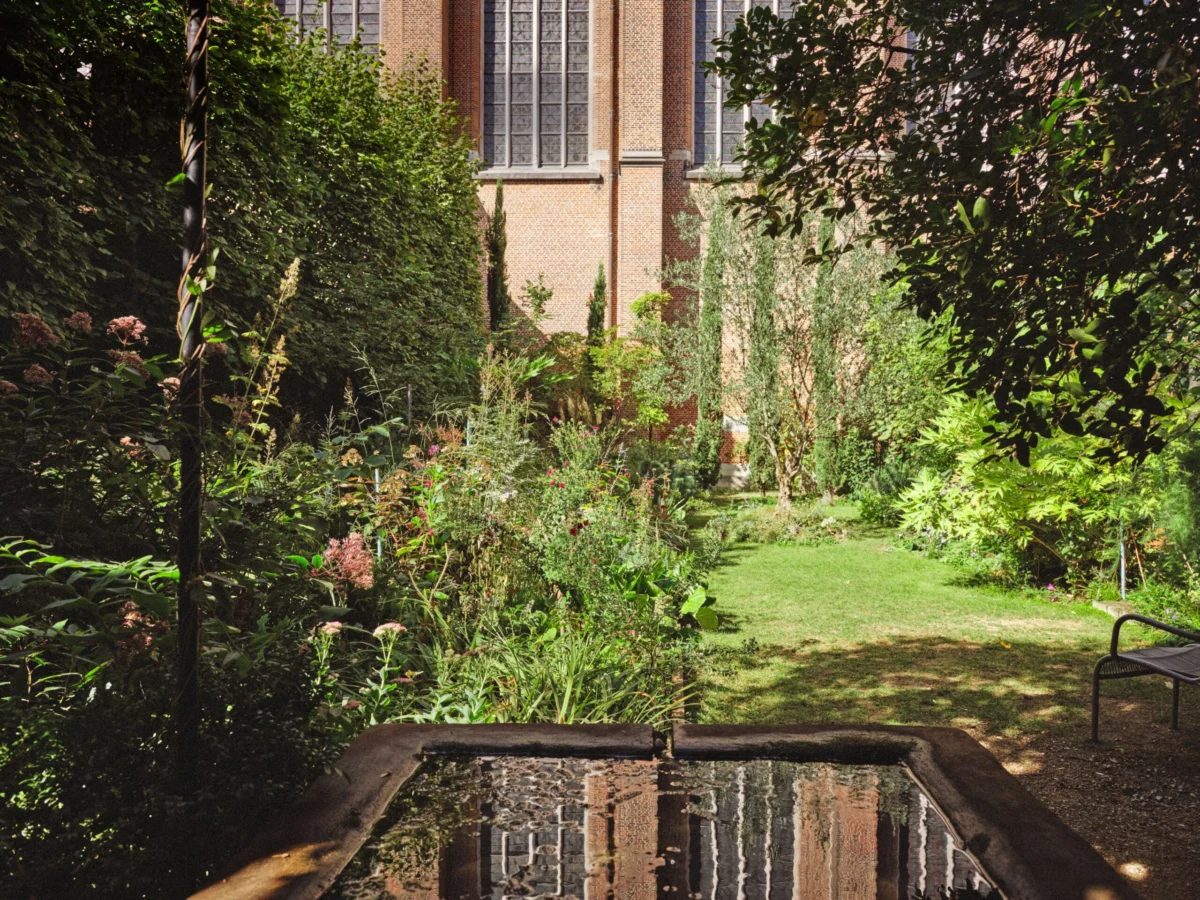
Running parallel to the street and encompassing roughly 4,800 square feet, the Antwerp garden functions as an immersive, deeply layered seasonal experience. What stands out most to visitors and architectural critics alike is the rich layering of its features, blending artistic expression with deep historical and biblical symbolism.
A single, majestic olive tree stands at the center of the layout, serving as an ancient symbol of peace, resilience, and longevity. Tall, slender cypresses line the perimeter walls, physically and metaphorically embodying the mystical connection between the earth and the heavens—an architectural nod to the poetic descriptions of the enclosed garden found in the biblical Song of Songs. A small, tranquil water basin represents the traditional source of life, while a continuous, winding path echoes the historic monastic walks designed specifically for silent contemplation and prayer.

Yet, these overarching symbolic themes form only one layer of the incredible density that defines the garden as distinctly his own. Over the years, van der Hilst has meticulously cultivated roughly 500 distinct plant species within the enclosure. This botanical treasury is further amplified by 5,000 tulips—a fitting tribute to his well-documented expertise in tulip history and rare bulb cultivation—alongside another 2,000 bulbous flowering plants that erupt in vibrant color at various times of the year.
Rejecting conventional landscape design tropes, there are no rigidly ordered beds and no strict, symmetrical layouts. To achieve his overarching vision of an abundant, primordial garden of paradise, van der Hilst deliberately chose to plant the vast majority of his botanical specimens individually rather than in homogenous groups or mass collections. This deliberate method serves as a living testament to nature’s diverse, unadulterated richness.
"Through this individual planting," van der Hilst explains, "I can maximize the variety of species, textures, colors, flowering periods, and foliage contrasts, while simultaneously fitting my use of the garden as a plant lab."

Because of this sophisticated, highly individualized approach to planting, every single visitor encounters a radically different visual experience depending on the day, week, or month they step through the gate.
"I strive—and succeed—to have flowers in the garden every single day of the year, thereby giving it an aesthetic appeal even in winter," he notes proudly.
The philosophical underpinnings of the garden draw heavily on ancient horticultural traditions. Concepts of transience, eternity, and altered perspective have been prized in the folklore and mythology of garden-making ever since the mythical Eden. By sealing a garden off completely from the chaotic sounds and sights of the surrounding city streets, the designer effectively opens it vertically toward the endless, uninterrupted expanse of the sky.

Van der Hilst’s artistic output extends well beyond living botany. Known globally as an expert in tulip history, his creative footprint is also visible through his sculptural and ceramic works. Visitors walking through the lush pathways may encounter La Tulipe Noire, a striking bronze sculpture designed by van der Hilst, or admire his custom-designed vessels, such as the Tuber vases he created for Mobach Keramiek and stunning Murano glass tulip vases manufactured in collaboration with Seguso.
Though he is internationally celebrated for his deep knowledge of rare bulbs and floral history, the Hortus Conclusus remains remarkably discreet, hidden in plain sight within the Belgian cityscape.
"It’s the first garden I’ve designed that I can occasionally open to the public," van der Hilst says.

The sanctuary cannot be casually stumbled upon by standard foot traffic; instead, it is visited strictly by appointment, discovered organically through word of mouth, or experienced during special open garden days. During these limited windows, the space draws anywhere from hundreds to thousands of eager visitors per season.
This inherent paradox—simultaneously private and public, hidden yet accessible—reflects something deeply essential about the character of Antwerp itself, a sophisticated European city whose greatest cultural, artistic, and architectural riches largely live behind closed doors. For those fortunate enough to seek it out and gain entry, the rewards often include a quiet moment of reflection accompanied by a warm cup of tea brewed directly from homegrown herbs, served in delicate porcelain cups that van der Hilst crafted with his own hands.
Having called Antwerp his home since the early 1990s, van der Hilst has firmly rooted his life, his art, and his philosophy in the historic fabric of the city. Through his meticulous care, the once-forgotten churchyard on Mechelseplein has been reborn, proving that even within the densest urban landscapes, the timeless magic of a secret garden can still take root and flourish.