 11
The update centers on the program’s Flexible Bilt Cash option, which allows cardholders to earn 4% back in Bilt Cash on everyday purchases in addition to regular points. Current cardholders who utilize this feature have until the day before their next card renewal anniversary to formally opt out of the upcoming program changes if they wish to keep things status quo.
For prospective cardholders, the timeline is even tighter. Individuals looking to secure the Flexible Bilt Cash option must submit an application before the end of 2026. Beginning Jan. 1, 2027, all new cardholders will be automatically enrolled in Bilt’s updated rewards setup with no option to switch back.
The announcement has triggered a wave of questions across the points and miles community, with the most pressing concern revolving around which rewards structure provides the best value. Because Bilt’s program has evolved into a multi-layered ecosystem, determining the right path depends heavily on individual spending habits, monthly housing costs, and card selection.
For consumers who have been on the fence about acquiring a Bilt credit card, the conclusion of 2026 serves as a hard deadline. Anyone who successfully applies before Jan. 1, 2027, retains the ability to choose Flexible Bilt Cash, the feature that grants 4% back on daily spending alongside base point earnings. Those who wait until 2027 or later will be locked into Bilt’s new system from day one, with zero opportunity to access the legacy earning track.
Importantly, submitting an application before the deadline does not permanently trap a cardholder in the older system. Users who opt for Flexible Bilt Cash retain the freedom to transition to the new benefits structure at any time. However, because the reverse is not permitted once the choice is finalized on a card anniversary, applying early keeps both doors open while waiting closes one permanently.
This distinction matters most for consumers who plan to funnel substantial everyday spending through the card. Cardholders who intend to use the product strictly for rent or mortgage payments without putting significant external spend on the account will likely find that the updated rewards setup serves them just as well, eliminating any immediate need to rush an application.
For applicants aiming to preserve the Flexible Bilt Cash option, the choice largely narrows down to two premium products: the Bilt Palladium Card and the Bilt Obsidian Card. Both of these cards interact directly with Point Accelerators, which represent the primary financial incentive for keeping Flexible Bilt Cash as an active option.
Bilt’s Point Accelerators permit Palladium and Obsidian cardholders to generate an extra point per dollar on top of standard earnings by redeeming $200 increments of Bilt Cash. Each accelerator applies to up to $5,000 in purchases, and cardholders can utilize this mechanism up to five times per calendar year. Because the Palladium Card inherently earns 2x points on all general spending, utilizing accelerators can elevate its return to 3x rewards on up to $25,000 of annual expenditure.
Meanwhile, the no-annual-fee Bilt Blue Card lacks access to Point Accelerators. For users eyeing the Blue Card, the extra Bilt Cash is restricted to auxiliary perks such as rideshare discounts and food delivery credits. Because these cardholders would likely migrate to the updated rewards track over time anyway, there is little urgency to accelerate an application for the Blue Card before the deadline.
Choosing between the Palladium and Obsidian cards depends primarily on expected spending volume. The Palladium Card functions best as an everyday spending driver, offering 2x points on all purchases and pairing that earning power with an annual allocation of Bilt Cash and hotel credits. The Obsidian Card is tailored for consumers who concentrate their spending heavily on dining and groceries, offering 3x points in those categories, 2x on travel, and 1x elsewhere, accompanied by a lower annual fee and full Point Accelerator compatibility.
Much of the frustration surrounding the latest Bilt announcement stems from a fragmented timeline where key dates do not neatly align. While certain program adjustments take effect universally on Jan. 1, the most critical deadlines are tied directly to individual cardholder anniversary dates.
New applicants retain the right to select Flexible Bilt Cash through Dec. 31, 2026. On Jan. 1, 2027, newly approved cardholders will be restricted exclusively to the updated benefits, and the frequency of utilizing Bilt Cash for hotel bookings will shift from a monthly allowance to a twice-yearly benefit.
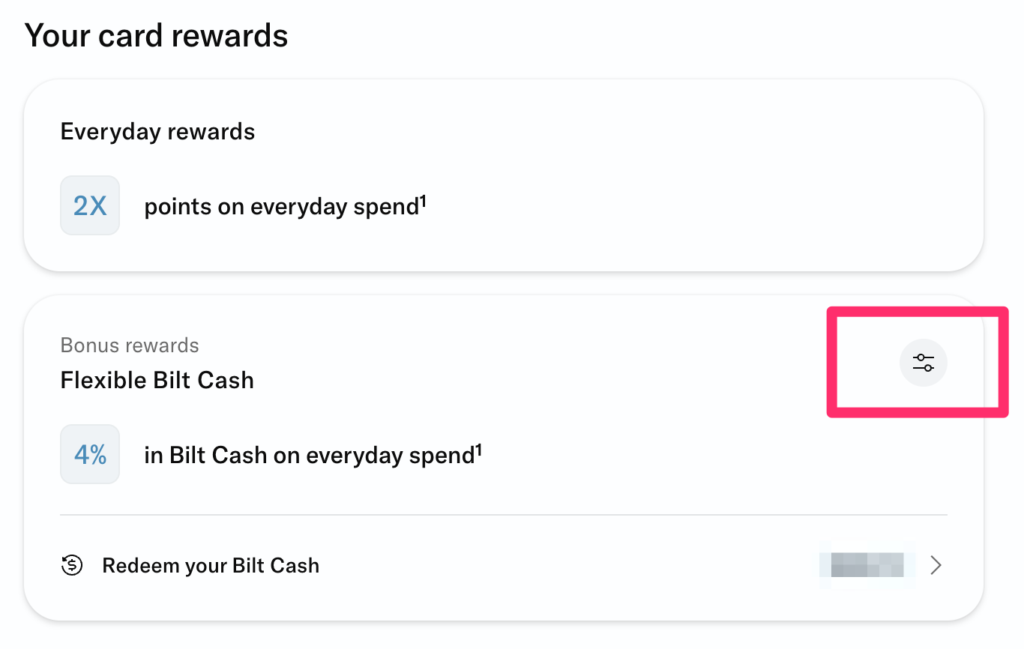
For existing cardholders, the crucial deadline arrives on the day before their card anniversary. This marks the final opportunity to elect Flexible Bilt Cash. On the anniversary date itself, any member who has not actively chosen Flexible Bilt Cash is automatically transitioned to the new benefits framework. Furthermore, once that anniversary passes, the ability to freely toggle back and forth between earning structures is permanently eliminated.
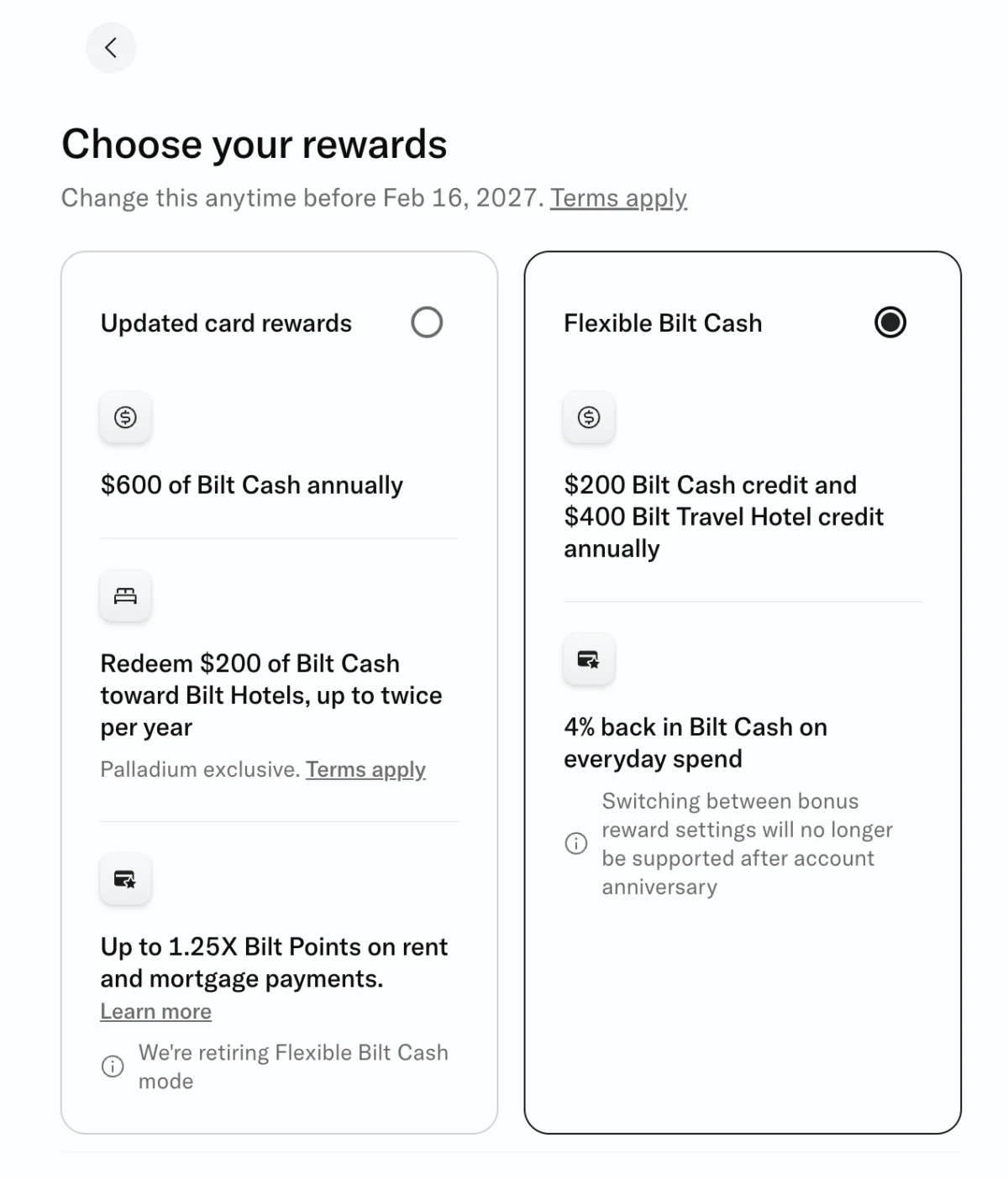
Current cardholders do not need to wait for their specific anniversary date to register their preference, as the selection interface is already active within the Bilt mobile application and online portal. Navigating to the card rewards section reveals the account settings where users can review their current status.
The nomenclature displayed within the app reflects recent updates to the program terminology, which can occasionally cause confusion for users accustomed to the original launch terms. Members who previously utilized Housing-only earning modes will find that the updated card rewards mirror that system, enhanced by a new package of annual credits. For instance, the Bilt Palladium setup transitions from combining $200 in Bilt Cash and $400 in hotel credits into a consolidated $600 Bilt Cash allocation under the newer framework.
The interface confirms that users can adjust their selection at any point prior to their individual deadline, meaning an initial choice is not irreversible before the anniversary date arrives. Once that threshold is crossed, however, users may transition from Flexible Bilt Cash to the updated rewards, but the reverse path remains permanently closed.
In recent media communications, Bilt representatives noted that the majority of cardholders currently bypass the Flexible Bilt Cash option in favor of simpler alternatives. While internal metrics may support this claim, industry analysts suggest it reflects the initial complexity of the program’s rollout rather than the inherent superiority of the simpler track.
When Bilt launched its updated card structure with Bilt Cash as the sole housing reward mechanism, the resulting confusion prompted the company to introduce a secondary, more straightforward earning track just days later. Maintaining two distinct earning paths naturally divided users, with many opting for the most easily understood option.
Industry observers also point to potential economic motivations for winding down the legacy option. Flexible Bilt Cash delivers the highest returns to cardholders who route heavy everyday spending through their accounts—precisely the customers who represent the highest reward costs for the issuer. As programs mature, streamlining reward structures often serves to manage long-term liability while simplifying marketing efforts for the broader consumer base.
Evaluating whether to keep Flexible Bilt Cash does not require advanced financial modeling, but it does require comparing monthly credit card expenditure against monthly housing payments.
Bilt Cash unlocks points on rent or mortgage payments at a rate of $30 per 1,000 points, meaning the 4% back structure equates to roughly 1.33 housing points per dollar spent. Any surplus Bilt Cash can be applied toward Point Accelerators, which cost $200 in Bilt Cash and generate an extra point per dollar on up to $5,000 in subsequent purchases.
For heavy spenders, particularly those holding the Palladium Card, reaching a spending threshold equivalent to roughly 75% of a monthly housing payment plus an additional baseline amount allows them to maximize both full housing points and all five annual Point Accelerators. For example, a cardholder with a $2,000 mortgage and $3,500 in monthly everyday spending will generally yield a significantly higher point total under the Flexible Bilt Cash structure compared to the updated rewards track, while retaining residual Bilt Cash for external perks.
For cardholders who do not process rent or mortgage payments through Bilt at all, the Flexible Bilt Cash option remains overwhelmingly the superior choice.
Ultimately, Bilt’s ongoing adjustments represent an effort to streamline a complex rewards ecosystem, but they currently require members to navigate yet another critical decision under a deadline. By comparing monthly card volume against housing expenses, cardholders can determine whether to preserve their flexibility before the window closes.