 11
ADA, Oklahoma — At East Central University, nestled in the heart of rural Oklahoma, the realities of a shifting political landscape are hitting close to home. Out of four critical professor positions sought by the institution—including posts in history and criminal justice—two remain entirely unfilled. Recruitment efforts faltered after fewer candidates than usual applied, and a significant number of prospective applicants ultimately withdrew their interest altogether. In the computer science department, the hiring process proved equally challenging; the top-choice candidate turned down the job offer, forcing the university to settle for a second-choice applicant.
This mounting hiring trouble is not isolated to East Central University. Leaders across Oklahoma argue that the staffing difficulties plaguing regional, public universities stem directly from Governor Kevin Stitt’s aggressive efforts to dismantle traditional job protections for faculty. According to higher education advocates and campus administrators, these sweeping policy changes are severely undermining the ability of schools located in remote or rural locations to attract and retain vital academic talent.
"The governor, in messages he has delivered to us, says he disagrees with academic freedom and thinks professors at the end of their careers aren’t doing much," said ECU President Wendell Godwin. "But we have a process for getting rid of professors who are not effective, whether they are tenured or not."
The turbulence in Oklahoma higher education mirrors broader national trends. Following in the footsteps of former President Donald Trump’s second-term shakeup of higher education—which featured funding cuts, aggressive bans on diversity programs, and targeted litigation—Governor Stitt, a Republican nearing the conclusion of his second term, issued his own strict crackdown on Oklahoma colleges.
The executive actions, enacted in February, target the state’s public higher education framework through two primary directives. The first executive order explicitly forbids publicly funded regional universities and community colleges statewide from granting tenure to any newly hired faculty members. Crucially, the order spares the state’s flagship research institutions, the University of Oklahoma and Oklahoma State University. Tenure, a long-established form of job protection earned over time through rigorous peer-review approval processes, is designed to shield academics from political or institutional retaliation when teaching and researching controversial ideas.
The second executive order demanded a comprehensive "return-on-investment analysis," with Stitt asserting that universities must become strictly more accountable to tuition-payers and everyday taxpayers.
University leaders and state lawmakers from rural Oklahoma communities have expressed profound bewilderment at finding themselves directly in the crosshairs of a national culture war issue.
"You hear about the ‘woke agenda’ on Fox and CNN news today," Godwin said. "I recently had a parent ask if we were going to indoctrinate their student. On a woke meter from 1 to 10, we’re probably not even a 1. It’s not really an issue in rural Oklahoma."
Legislative efforts to codify and expand these restrictions have also surfaced under the Golden Dome. Oklahoma State Senate Bill 1782 was introduced to expand the tenure ban to all public universities statewide. After passing the Senate Education Committee in March, however, the legislation ultimately languished. Similar bills targeting tenure at public colleges have been introduced over the past year by Republican lawmakers in approximately half a dozen other states, including Arkansas, Kansas, Kentucky, Nebraska, North Dakota, and Texas.
While no state has yet fully eliminated tenure entirely, Stitt’s executive order stands as the most wide-ranging assault on the practice to date. It directly targets the six institutions comprising the Regional University System of Oklahoma (RUSO)—schools that serve as the higher education anchors for their respective communities and function as essential economic and cultural hubs for rural Oklahoma.
State funding allocations inherently favor OU and OSU, the state’s premier research universities. Those major institutions charge significantly higher tuition rates and leverage extensive out-of-state and international enrollment to bolster their operating revenues. Conversely, RUSO schools operate under strict affordability mandates to serve local populations. If the new tenure ban drives away top-tier faculty from campuses that are already under-resourced, critics warn that Oklahoma could be left with a fractured higher education system divided sharply between haves and have-nots.
"Oklahoma presents a really interesting case study," said Deepa Das Acevedo, an assistant professor of law at Emory University and author of the 2025 book "The War on Tenure." Acevedo noted that tenure bans disproportionately punish schools that are already struggling to recruit faculty. Furthermore, she explained, such policies send a chilling signal to potential academic recruits that state leaders want to keep them professionally insecure and do not truly value their institutions.
National education researchers view Stitt’s executive order as yet another systemic blow to the viability and prestige of rural higher education.

"It is a continuation, in my view, of the disregard or the permanent, second-class citizen status that regional universities have in their states," said Cecilia Orphan, associate professor of higher education at the University of Denver and founding co-director of the Alliance for Research on Regional Colleges. "This is a new way of saying these institutions are not real universities and their students are not worthy of a real university education."
Why Tenure Matters
For generations, tenure has remained a cornerstone of American higher education. It typically requires professors to complete a rigorous six- to seven-year trial period and successfully pass strict peer reviews before earning the designation.
Under Stitt’s new rules, however, regional and community colleges are restricted to hiring faculty exclusively under fixed-term, renewable contracts. These appointments are made explicitly contingent upon ongoing performance evaluations and direct "alignment with workforce and Oklahoma economic needs."
Even before the governor’s directive, the RUSO Board of Regents had been pushing university presidents to better align their academic faculties with currently enrolled students and shifting regional workforce demands. In some instances, launching brand-new degree programs designed to address cutting-edge industry needs requires hiring entirely new faculty amid an already highly competitive national job market.
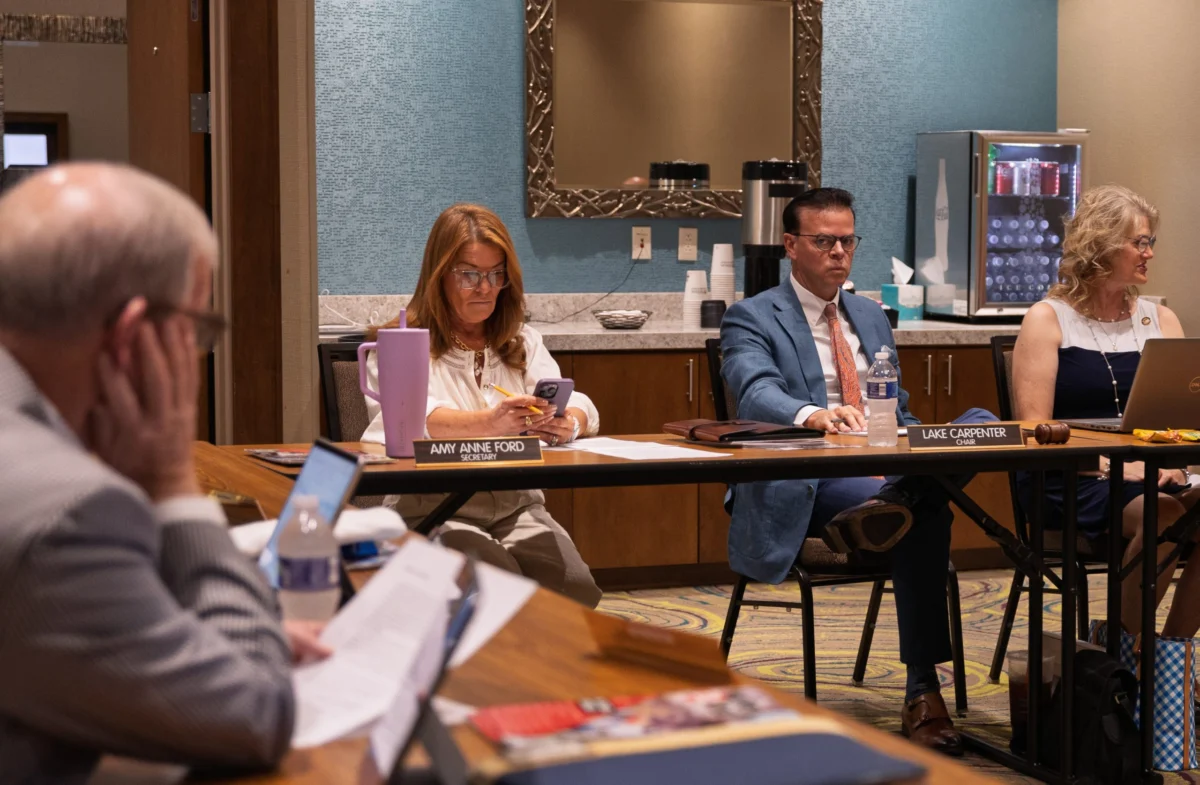
"You’re going to miss out on the best of the best," said Regent Amy Anne Ford, who served as the board’s point person on compliance with the governor’s executive order. "When you’re looking at some of these smaller communities, like Alva or Ada, that already have a difficult time recruiting because they’re not major metropolitan areas, then you add this barrier, it makes it that much more difficult."
Data compiled by the RUSO Board of Regents indicates that across the regional college system, 51 percent—or 661 of the 1,287 full-time faculty members—are currently tenured, with another 269 employees progressing along a tenure track. Ford noted that the RUSO Board of Regents adopted a proactive rule committing to grant tenure to all individuals already hired on a tenure track to successfully mitigate potential litigation.
Nevertheless, Stitt’s order has significantly shifted the baseline terms of employment for incoming personnel. As of late July, the six RUSO universities had collectively hired 44 new faculty members who otherwise would have been placed on a traditional tenure track, according to data from the Board of Regents.
Regional universities carry a distinct institutional mission: providing accessible, localized college degree programs and acting as primary drivers of regional economic development. Affordability remains a central priority for these campuses. For in-state residents, the cost of attending a RUSO institution averaged $17,557 per year during the 2025–2026 academic year, compared to $27,293 at the state’s two major research universities. Moreover, a substantial portion of RUSO students save roughly $7,700 annually in on-campus housing and food expenses by continuing to live at home while pursuing their higher education.
"Oklahoma has a system of regional publics that it should be very proud of and work very hard to protect, and not hurt or erode," Orphan said.
Competing Without Tenure
Higher education across the United States has undergone a dramatic structural shift away from tenure over the past four decades. Today, approximately 75 percent to 80 percent of all faculty nationwide serve on contingent, non-tenure-track appointments, driven largely by gradual state funding reductions and fluctuating student enrollment patterns.
At the same time, the popular political notion that tenured faculty members are virtually impossible to terminate is demonstrably false. Acevedo’s extensive research into two decades of publicly available data revealed that the vast majority of faculty terminations actually occur at public institutions. This empirical finding undercuts political arguments that tenure acts as an insurmountable roadblock preventing universities from weeding out underperforming staff.
"What tenure is doing, fundamentally, is providing job security for individuals who face high barriers to entry," Acevedo explained. "It takes years of work and expensive degrees to get into this work."

Despite mounting concerns from faculty and academic researchers, the chairman of the RUSO Board of Regents remains outwardly optimistic about the road ahead.
"I don’t think anyone could say what the long-term impacts will be," said Lake Carpenter, chairman of the RUSO Board. "I think this will take some adjusting, but we have to comply."
Carpenter pointed to several of the regional system’s flagship professional programs—such as pharmacy at Southwestern Oklahoma State University and optometry at Northeastern State University—which have historically succeeded in attracting top-tier faculty, as proof that the system can maintain its competitive edge.
"Just because there is no tenure track, there are other ways to recruit," Carpenter said. "Here’s an opportunity to show this can be done, to set the example for others to follow."
Perhaps This Won’t Be Permanent
At East Central University, faculty members already undergo rigorous annual evaluations, and tenure-track professors are subject to formal reviews every three years. Potential issues involving classroom management or instructional inefficiencies are regularly brought to light by students, who evaluate every instructor across all enrolled courses.
Godwin argued that these built-in accountability measures should position ECU as a model of institutional responsibility rather than a primary target for state intervention and suspicion.
"The irony is it’s the tenured faculty who will be the loudest in saying someone is not meeting the standard," he said. "’A’ players want to be surrounded by other ‘A’ players."
Despite the cloud cast by the tenure crackdown, a handful of ECU’s newly recruited faculty members chose to move to Ada in the hope that traditional job protections might eventually be restored.
"We are pretty hopeful that perhaps this won’t be permanent," Godwin said.
There remains a distinct possibility that the new restrictions could sunset alongside Governor Stitt’s tenure in office, which concludes in January. Already, state lawmakers are organizing around shared concerns for RUSO campuses located within their legislative districts. Some representatives have vowed to pressure the incoming governor to let Stitt’s executive order expire 90 days after he vacates the office, a lapse that will occur automatically unless his successor chooses to renew the directives.
With nearly 90 percent of RUSO graduates choosing to remain in Oklahoma to build their lives and careers, supporting local institutions is seen by many lawmakers as an economic imperative. State Representative Ronny Johns, a Republican representing Ada, emphasized that it is long past time for the state’s regional colleges to receive robust backing.
"You hear all of us say we want our kids and grandkids to be able to stay in the state and work here," Johns said. "That should motivate all of us—the governor, Senate, House—to do all we can to promote those schools and support those schools."